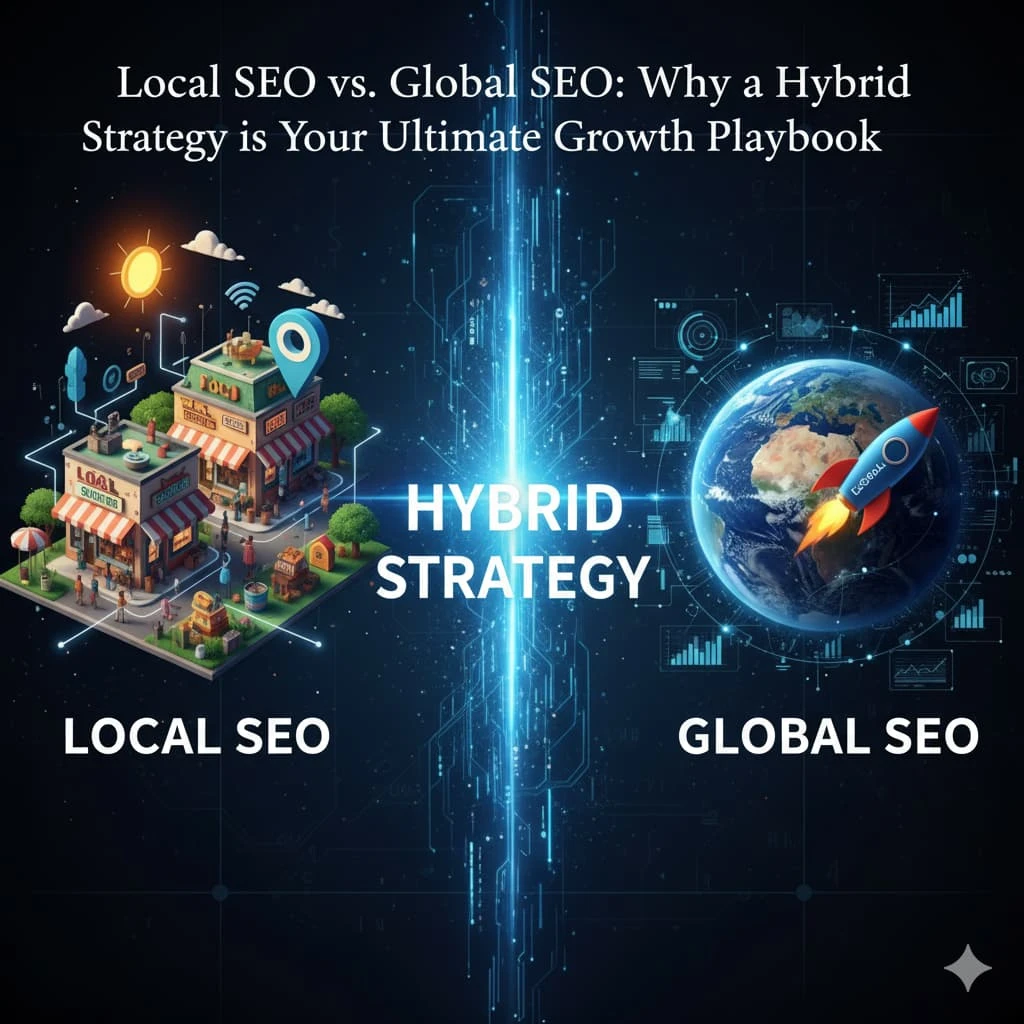
In the vast world of digital marketing, one fundamental question often surfaces: Should you focus your search engine optimization (SEO) efforts locally or globally? For years, businesses often chose one path over the other. But in 2025, with search engines getting smarter and user intent becoming paramount, that binary choice is a relic of the past.
The truth? The most powerful growth strategy isn't about picking sides. It's about a hybrid approach that intelligently blends Local SEO and Global SEO to create an unstoppable digital footprint. This guide will break down both, revealing why a combined strategy is your ultimate playbook for sustained growth.
Understanding the Fundamentals: Local vs. Global SEO
Before we talk about blending, let's clarify the distinct goals of each.
Local SEO: Dominating Your Backyard
Local SEO is the practice of optimizing your online presence to attract customers in your specific geographic area. It's all about connecting with users who are searching for products or services "near me" or within a defined locality (e.g., "coffee shops in Brooklyn," "plumber near me").
- Who it's for: Brick-and-mortar stores, service-area businesses (plumbers, electricians, real estate agents), restaurants, and any business that relies on local foot traffic or serves a specific geographic region.
- Key Focus Areas: Google Business Profile optimization, local citations, customer reviews, location-specific keywords (e.g., "best pizza [city name]"), local content.
- The Goal: To appear in the "Local Pack" (the map results on Google) and top organic results for local searches.
Global SEO: Reaching Beyond Borders
Global SEO (often synonymous with International SEO or National SEO) focuses on optimizing your website to rank in search results across different countries, regions, or for a broad, non-localized audience.
- Who it's for: E-commerce businesses shipping worldwide, SaaS companies with international clients, content publishers, large corporations with global reach, and brands without a physical presence.
- Key Focus Areas: Multilingual content, hreflang tags, international link building, domain strategy (ccTLDs, subdomains, subdirectories), global keyword research.
- The Goal: To rank prominently for relevant keywords regardless of the user's location, expanding market reach exponentially.
The Outdated Debate: Why Choosing One is a Missed Opportunity
In 2025, the idea of an "either/or" choice between Local and Global SEO is deeply flawed. Here’s why:
- Google's AI Understands Nuance: Search engines, powered by sophisticated AI, are better than ever at discerning user intent. A user searching "best running shoes" might be looking for general reviews (global intent), but if they follow up with "running shoes near me," their intent instantly becomes local. You need to be ready for both.
- The "Near Me" Phenomenon: Mobile search has blurred the lines. Even global brands benefit from local visibility when users are seeking their products or services in a specific location.
- Cannibalization & Overlap: Neglecting one means leaving a massive chunk of your potential audience on the table. A global brand with local branches still needs to attract nearby customers. A local business could expand its reach with globally optimized content.
The Hybrid Advantage: Your Ultimate Growth Playbook
A truly effective strategy weaves Local and Global SEO together, creating a robust, multi-faceted approach that maximizes visibility and captures diverse customer intent.
1. Foundational Global SEO with Local Targeting:
- Global Core: Build a technically sound website with strong global SEO principles (fast loading, mobile-friendly, excellent content, strong internal linking). This is your universal foundation.
- Local Landing Pages: For each physical location or service area, create dedicated, optimized landing pages. These pages should feature local keywords, business hours, directions, embedded Google Maps, and local testimonials.
- Local Schema Markup: Implement LocalBusiness schema markup on these pages to tell search engines exactly what your business is, where it's located, and what it offers.
2. Content Strategy: From Broad to Hyper-Local:
- Global Thought Leadership: Create high-quality, globally relevant content (e.g., "The Future of E-commerce," "Comprehensive Guide to Digital Marketing") that establishes your overall brand authority. This content can attract links and broad organic traffic.
- Local Problem-Solving: Develop content specifically for local audiences. This could be "Best [Your Product/Service] in [City/Region]" lists, local event guides, or blog posts addressing local pain points (e.g., "Navigating Winter Driving in Colorado Springs"). This shows E-E-A-T for specific locations.
- "Near Me" Optimization: Don't forget the power of "near me" searches. Ensure your Google Business Profile is meticulously updated, as it's the primary source Google uses to answer these queries.
3. Review Management: Universal Trust, Local Impact:
- Encourage Reviews Everywhere: Actively solicit reviews on global platforms (e.g., industry-specific review sites, Trustpilot) and, crucially, on your Google Business Profile for each location.
- Respond to All Reviews: Engaging with reviews (positive and negative) shows both humans and AI that you are attentive and trustworthy—a critical E-E-A-T signal. High-quality reviews boost both local visibility and global brand perception.
4. Leveraging AI for Both Local and Global Insights:
- Local AI for Hyper-Personalization: Use AI tools to analyze local search trends, predict demand in specific areas, and even personalize local ad copy for maximum relevance.
- Global AI for Market Expansion: AI can identify new international markets, analyze competitor strategies in different countries, and help translate/localize content effectively, considering cultural nuances.
- AI Overviews: Both local and global content need to be structured for AI Overviews. Ensure your content directly answers questions, uses clear headings, and provides concise summaries that AI can easily pull.
Conclusion: No Longer a Choice, But a Synergy
The outdated "Local SEO vs. Global SEO" debate is over. In 2025, the most effective strategy for sustainable online growth is a unified approach. By building a strong global foundation and meticulously tailoring your efforts to local needs, you're not just casting a wider net; you're creating a precisely targeted, incredibly powerful magnet that attracts customers from across the street and around the world. Embrace the hybrid, and unlock your ultimate growth playbook.
FAQs
Q: Can a small business benefit from Global SEO?
A: Yes, even a small local business can benefit from elements of Global SEO by creating content that appeals to a broader audience (e.g., how-to guides related to their expertise) which can attract global links and establish broader authority. This, in turn, can boost their local rankings.
Q: Is it more expensive to do Global SEO than Local SEO?
A: Generally, Global SEO can be more complex and expensive due to factors like multilingual content, international hosting, and managing multiple country-specific search engine presences. However, the potential ROI from a larger market can justify the investment.
Q: How does Google's AI affect Local vs. Global SEO?
A: Google's AI enhances both. For Local SEO, AI improves understanding of "near me" intent and personalized local results. For Global SEO, AI helps with content translation nuances and identifying cross-border search trends. Both strategies benefit from content optimized for AI Overviews.